
The Industry of Everything
Why an abundance of everything doesn't mean you won't have to work

If you’ve been keeping track of my writing, you know that A) I’m a journalist and a content writer; and B) that I’m not a big fan of Artificial Intelligence.
I recently wrote an article about why I think AI won’t replace journalists any time soon, despite big tech gurus trying to convince us we’re all doomed.
Today, I’m going to expand that argument to everyone else, through a theory I call The Industry of Everything.
Let me tell you a quick story:
We had two music events in my city recently. One was an electronic music party, where a DJ was playing a set on stage. Entry, around $12. The other one was this older singer coming to town. He’s been on stage since the late 70s, has dozens of hits. He prepared this amazing concert with the philharmonic orchestra, a full-blown rock-and-roll band, back vocals, the whole shabang. Entry was $35 - $60, and he sold out five back-to-back concerts, each with an audience of 20,000+ people.
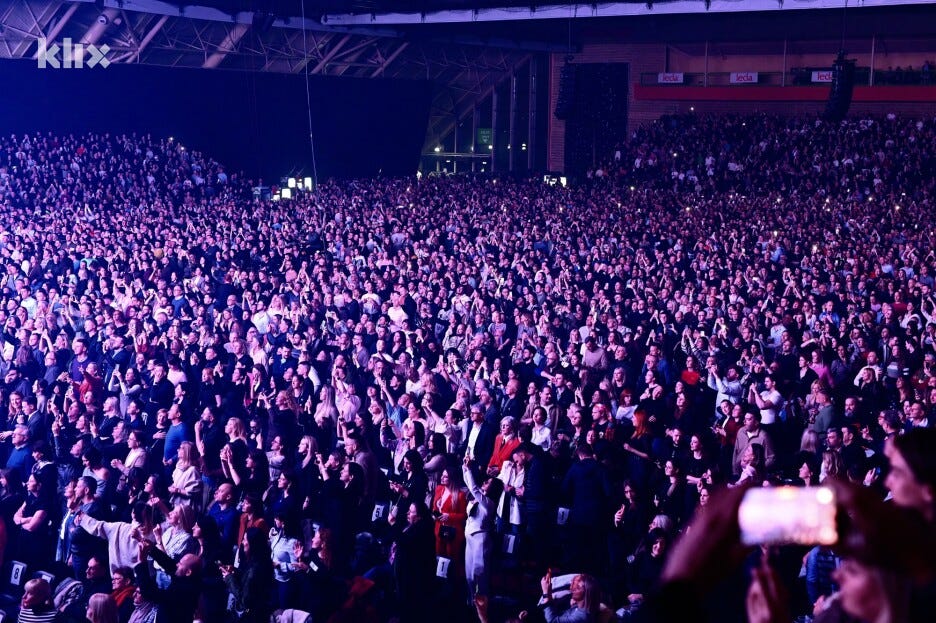
I don’t mind going to an electronic music party every once in a while, and I like concerts. Both are great, both have their use cases. I chose the concert this time.
Before going to the concert, I wanted to buy myself a fancy new shirt to wear.
I could choose between a branded, carefully designed US Polo shirt, and a generic, Chinese-manufactured cotton T-shirt. Both are great, both have their use cases. The first one costs around $35, the second one around $5. After walking around the shopping center for a while, I chose the US Polo one.
Then I realized I was hungry and wanted to grab a bite.
I could choose between a fancy Italian restaurant that was nearby, and a frozen pizza that I could put in the microwave and eat in five minutes. One is significantly more expensive than the other. Both are great, both have their use cases. I picked the restaurant, because it’s tastier, I like the ambience, and the service.
Do you see where I’m going with this?
The Industry of Everything
Do you know what industrialization is?
Industrialization is the transformation from manual labor to manufacturing, mechanized production, and technological innovation.
Music is now an industry.
Today, you can create pretty much any music with a click of a button. Every music instrument, every style of play, every little nuance is pre-recorded, sampled, and offered to you through software. That’s why these days we have an overabundance of songs, bands, musicians. DJs can prepare two-hour sets at home and play them in front of a crowd.
Just look at this quote from Ava Max’s Wikipedia page:
“In 2014, Max met Canadian record producer Cirkut, an acquaintance of her brother, at a dinner party in the Chateau Marmont. Max sang “Happy Birthday”, which led the two musicians to work together, writing hundreds of songs and releasing “Anyone but You” on SoundCloud in July 2016.”
Between 2014 and July 2016, a singer and a producer wrote “hundreds of songs”. In what, 500 days? That’s a new song every 2-3 days! Absolutely insane.
You know what’s also interesting? Almost all of those songs are trash. This is not a subjective opinion. These songs are entirely forgettable and have not left any mark on the world, the legacy of music, the audience, anyone. Most of the songs created this way are entirely meaningless. Even the songs that were summer hits, like “Sweet but Psycho,” or “Kings & Queens” will be forgotten in a few years.
Yet, we’re still listening to “old music”. A singer in his 70s still sells out five gigs in a row, because he has not industrialized his work.
The same thing applies to apparel.
Mass-produced Che Guevara T-shirts are great when you want to hit the gym or work in the garden. When you want to go to a fancy restaurant, you buy something that’s not built at that scale. That’s why Dolce Gabbana, Gucci, Versace, etc. are still so well positioned and so sought-after, despite the flood of cheap clothing and knockoffs.
Food has also been industrialized. You can get cheap food - frozen pizzas, canned fish, burgers, at a fraction of the cost you’d pay in a fancy restaurant. Yet, most good restaurants are so full you need to book a table a week in advance.
With Generative Artificial Intelligence, this industrialization is now hitting absolutely everything. Every aspect of our lives can be industrialized with AI.
It doesn’t mean the stuff it produces is as good as manual labor. Or that people will want only one, or the other.
Both are great, both have their use cases.
It just depends on the situation, and what you’re looking for at any given moment.
So don’t buy into the fearmongering that AI will leave us all out of work in 18 months. The Industry of Everything will only make mediocre stuff more abundant. There will always be room for great software designers, cybersecurity experts, journalists, and data analysts.